01
Protected pod
Dome and enclosure concept for environmental control, patient protection, and workflow separation.
AITB combines a protected medical pod, intelligent therapy-bed environment, powered transport chassis, modular support systems, and future AI-assisted clinical and logistics intelligence.

AITB is envisioned as a platform family that can support ICU overflow, evacuation, remote deployment, aircraft transfer, disaster response, and controlled protected care.
Dome and enclosure concept for environmental control, patient protection, and workflow separation.
Future integration points for pressure relief, warming, sensing, positioning, and treatment support.
Fold-under, raise/lower transport platform inspired by ambulance cot and aircraft loader principles.
Telemetry-ready design for device state, patient environment, maintenance, power, and readiness tracking.
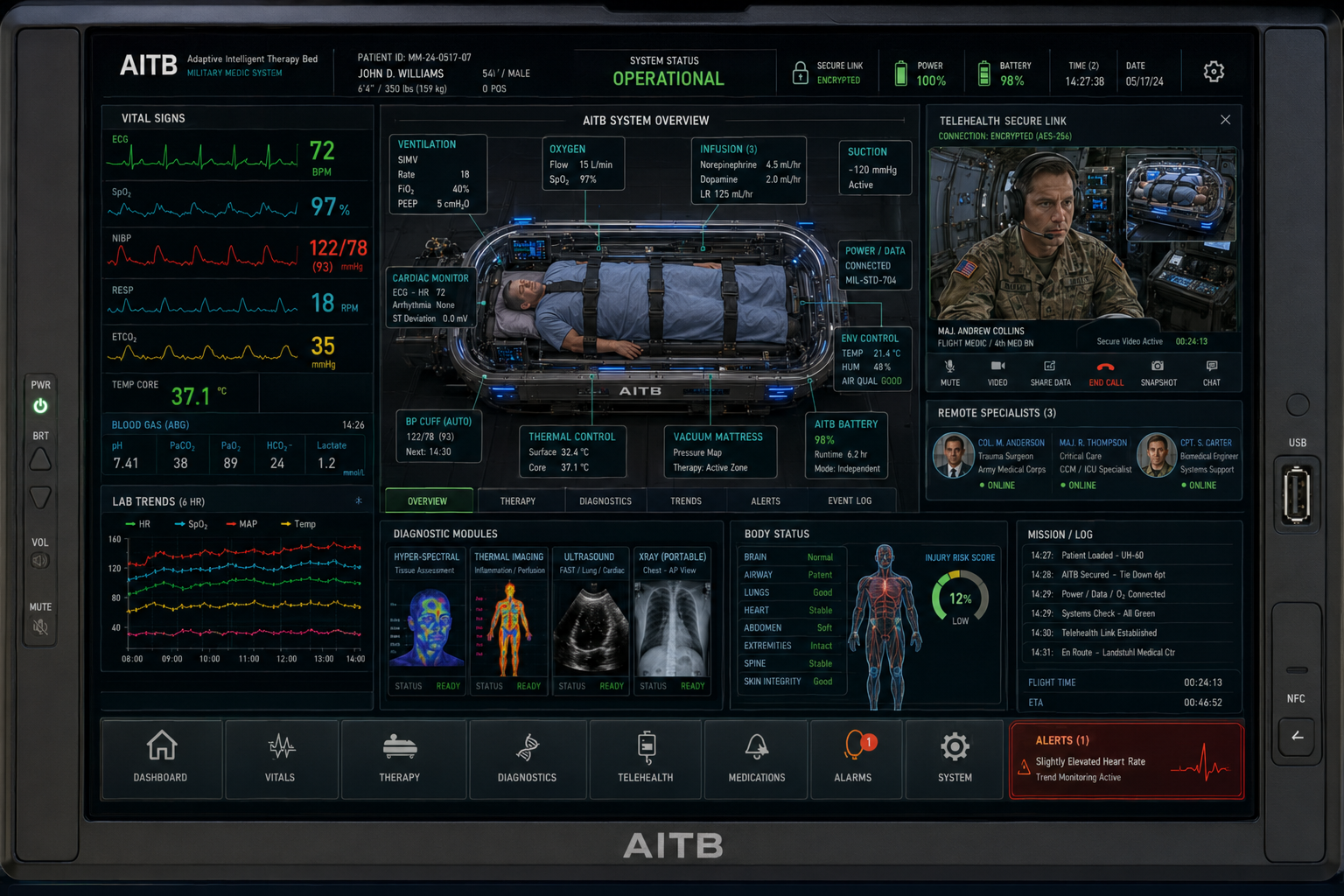
Patient stabilization, safe access, environmental control, monitoring ports, power routing, oxygen accommodation, and future device integration.
Compact surface-area chassis, lift synchronization, lockout logic, emergency lowering, rugged wheels, brakes, and field-service access.
Dimensional validation, tie-down points, alignment guides, cabin clearance, floor lock compatibility, and transport vibration controls.
Power state, maintenance status, environmental telemetry, system diagnostics, usage logs, and secure update workflow.
Prototype CAD, material selection, frame testing, enclosure safety, actuator validation, electronics protection, and serviceability.
Human factors, risk management, biocompatibility planning, electrical safety, cybersecurity, and clinical validation pathways.
The next build should include chassis dimensions, folded/raised states, patient envelope, aircraft door clearance assumptions, maintenance bay placement, materials, tolerances, and test protocols.