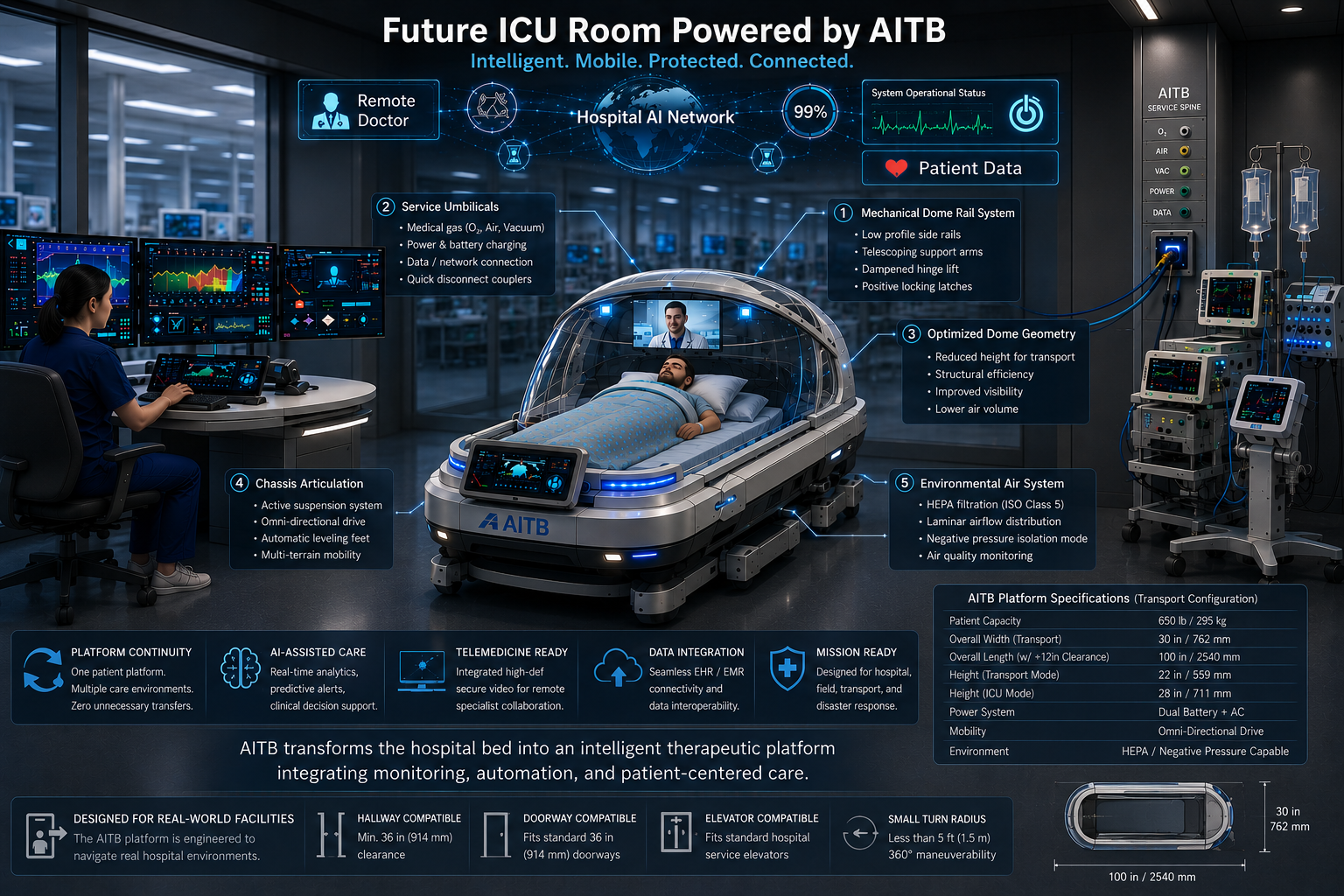
Mechanical dome rail system
Side linear rails, telescoping support arms, hinge bearings, locking latch points, and damping pistons.
 AITB Health
Adaptive intelligent therapy platform
AITB is presented as a continuous therapeutic mobility platform that combines protected transport, active therapy nodes, telemedicine, environmental airflow, sensing, and facility docking into one integrated patient-care architecture.
Real-world deployment focus
The current AITB ICU direction uses a slimmer chassis, narrower wheel track, compact sidewall thickness, tighter dome profile, and extended patient support length so the platform can move through medical facilities while still supporting a full adult patient, medical tubing, telemedicine, and environmental airflow.

Highest-value engineered subsystems
Side linear rails, telescoping support arms, hinge bearings, locking latch points, and damping pistons.
Oxygen, suction, air, data, power, filtered airflow, and rear docking spine with quick-disconnect couplers.
Lower transport height, reduced air volume, better optical clarity, and stronger aerospace-style curvature.
Narrow wheel track, active suspension, omni-directional drive, retractable stabilizers, and lift columns.
HEPA intake, laminar airflow, negative pressure mode, contamination indicators, and air quality monitoring.
Thermal regulation, vibration therapy, pressure redistribution, biometric sensing, and structural isolation.
Technical reference image