Full-Size Patient Envelope
Designed around full-body critical-care support with patient access, restraint points, airway access, and integrated equipment interfaces.
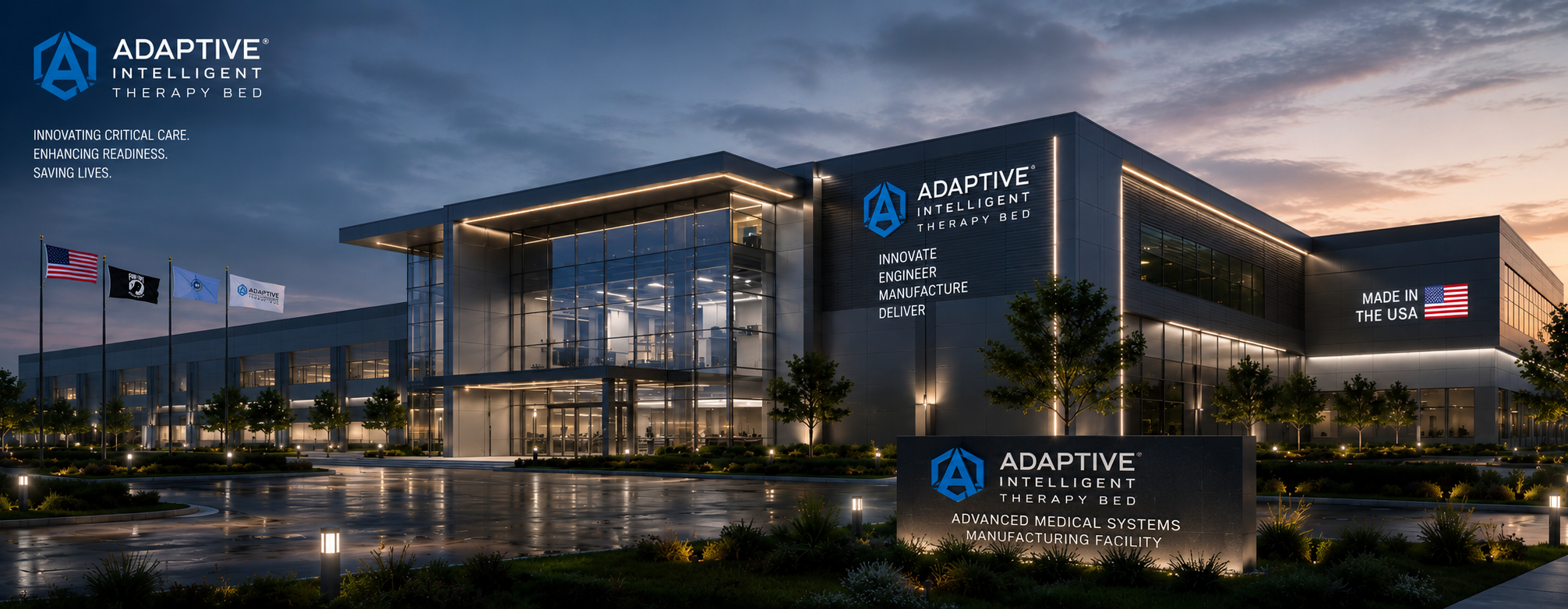
Dallas, Texas • Advanced Medical Systems Manufacturing
AITB Health is building a vertically integrated medical systems manufacturing and engineering platform centered around the Adaptive Intelligent Therapy Bed: a universal critical-care mobility system designed for military medevac, civil hospital continuity, disaster response, hospital surge capacity, field deployment, ICU therapy, and institutional medical transport.
One platform. Many missions.
The AITB strategy is a standardized full-length care chassis with modular medical, isolation, therapy, and transport packages. Civil and military AITB variants share a common intelligent platform philosophy, but differ in armor, power independence, chassis mobility, transport interfaces, and mission hardening.
Rotate the AITB platform to review the side-slide dome, telemedicine display, patient envelope, control module, rugged transport chassis, and mission-ready medical architecture.
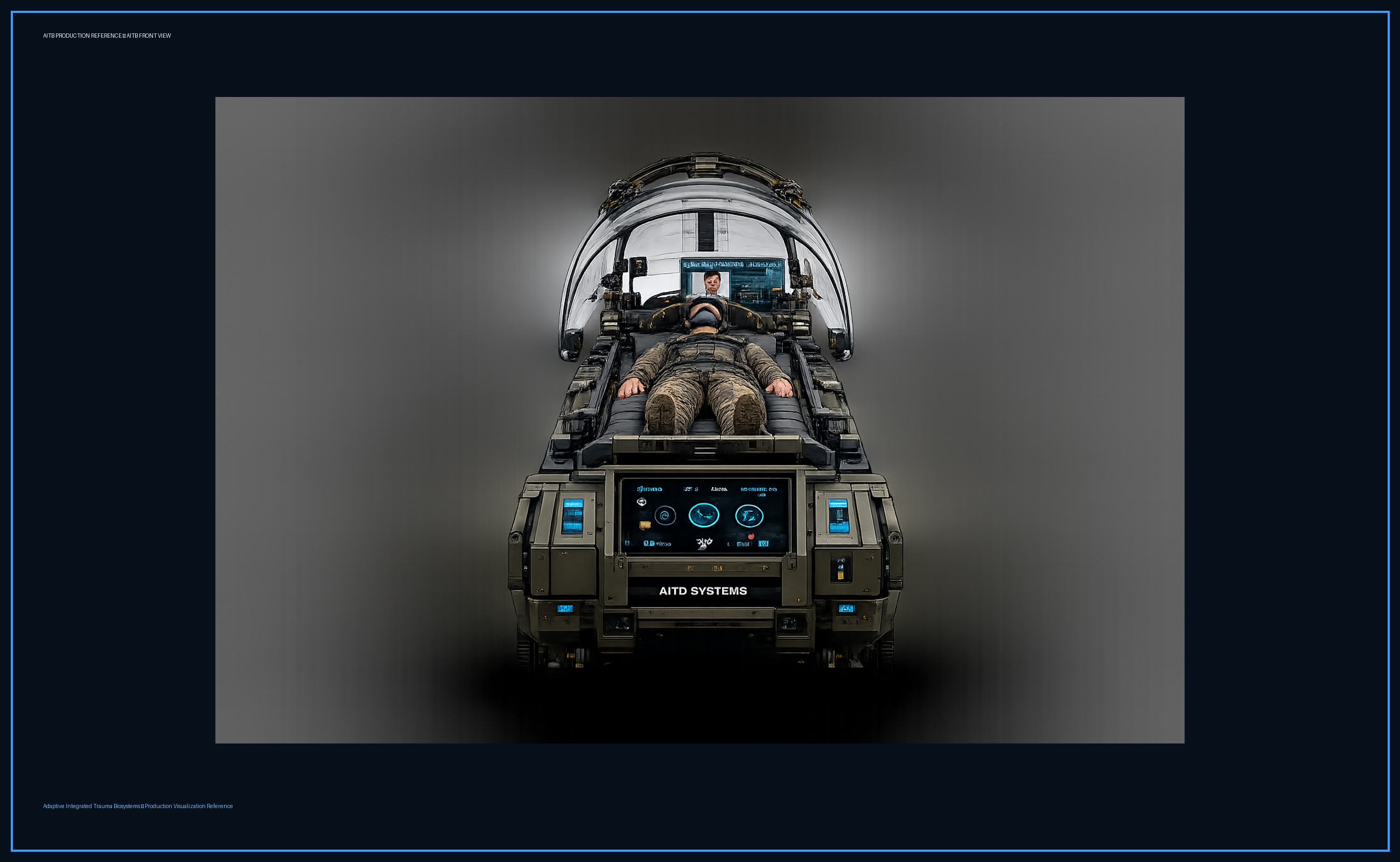
Designed around full-body critical-care support with patient access, restraint points, airway access, and integrated equipment interfaces.
Roll-in, securement-ready adapter concept for aircraft floors, field bases, vehicles, hospitals, and institutional transfer routes.
Side-hinged assisted dome concept for care access in confined aircraft cabins, field hospitals, disaster staging areas, and ICU environments.
Configurable monitoring, oxygen, suction, ventilation support, infusion support, telemedicine, isolation, and therapy systems.
Designed for future continuous monitoring, deterioration alerts, remote support, documentation assistance, and mission data capture.
Military aircraft and vehicles can conceptually return to standard mission configuration by removing adapter kits and receiver assemblies.
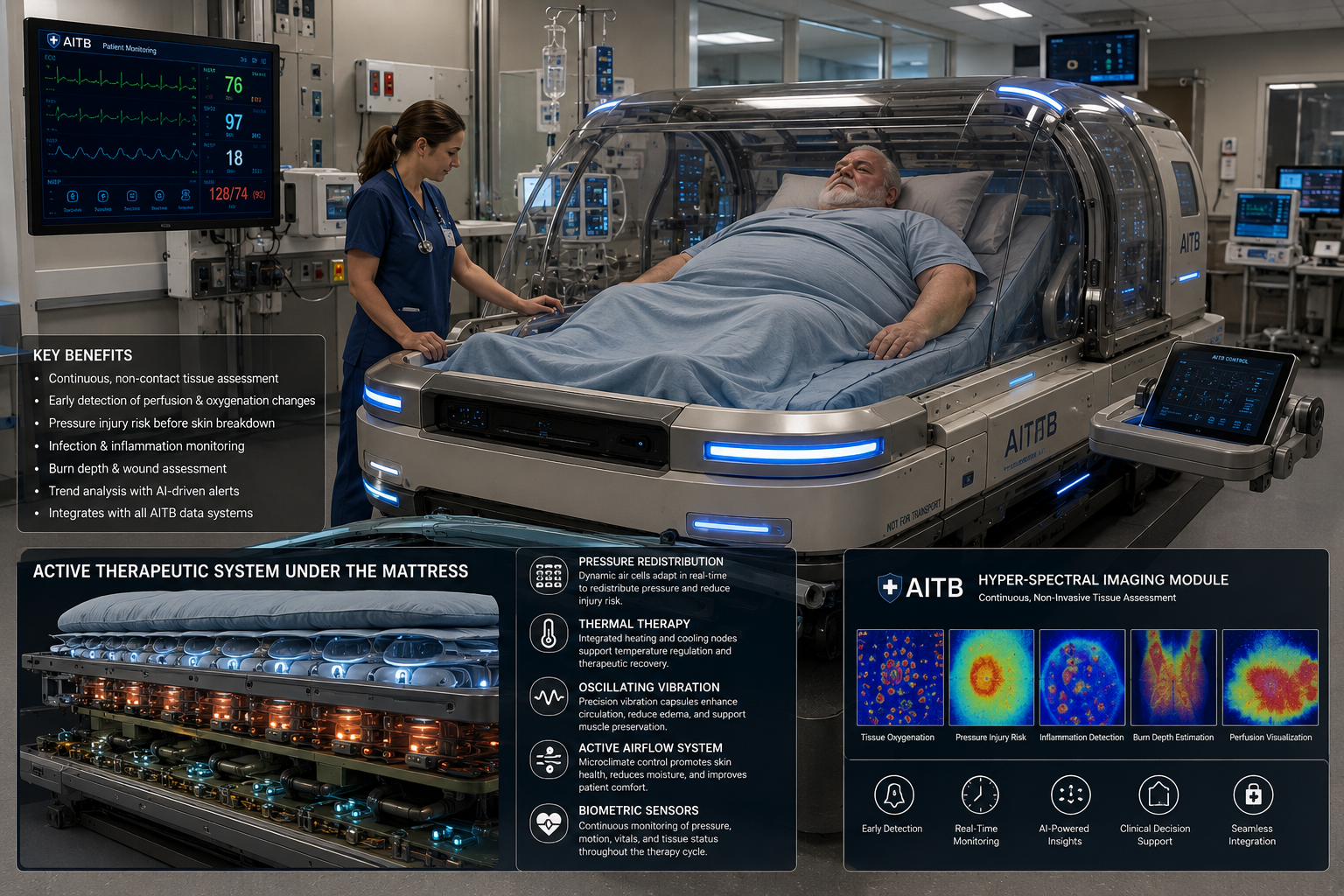
Civil AITB therapeutic platform
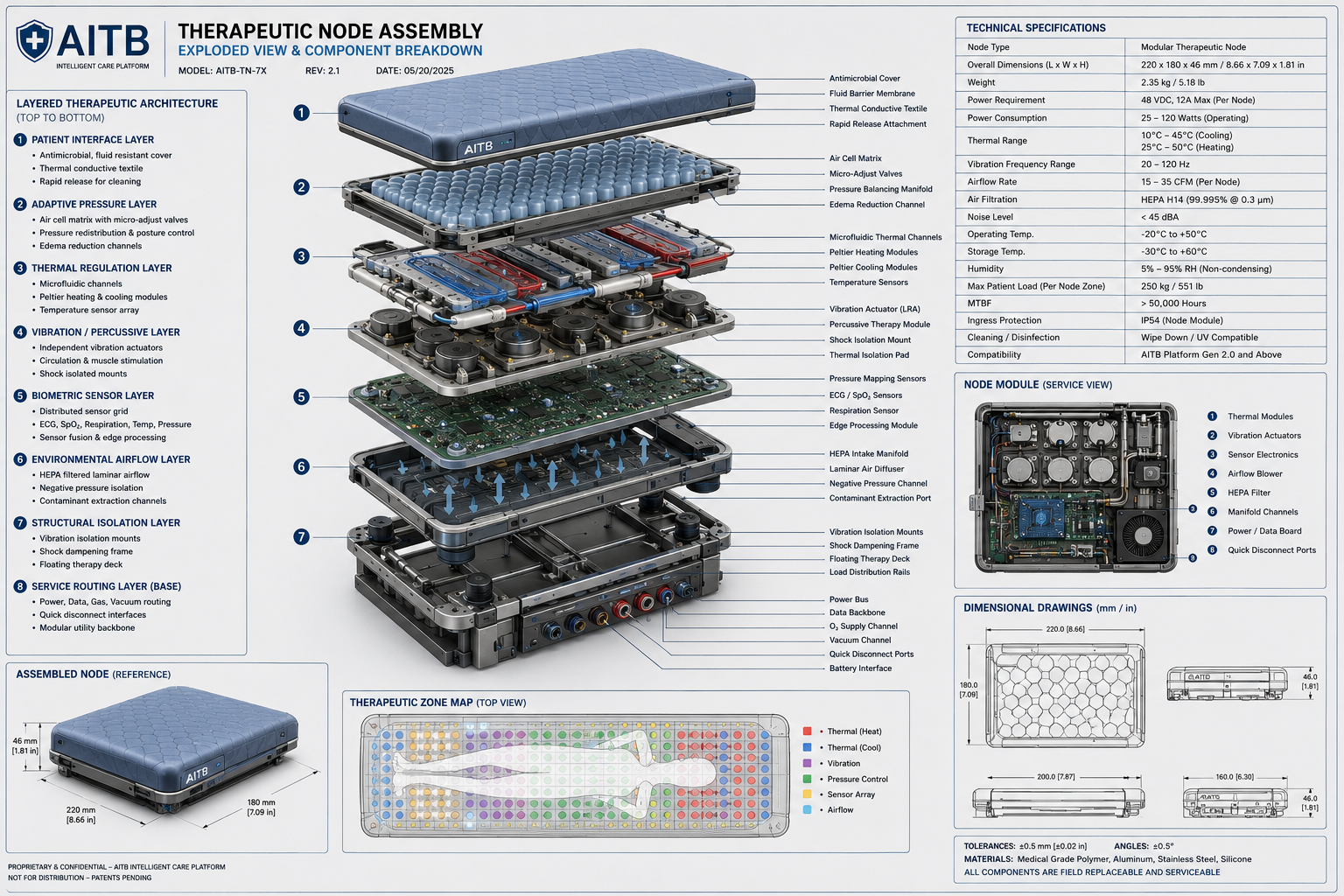
The Civil AITB therapeutic bed is distinct from the military-grade AITB platform. Civil models are optimized for hospital hallways, ICU rooms, emergency departments, ambulance transport, service elevators, smart facility docking, therapy modules, uninterrupted backup power, and patient-centered recovery workflows.
Compact chassis geometry, narrowed wheel track, hospital-floor mobility, service elevator compatibility, corridor navigation, and ambulance transfer support without military all-terrain hardening.
Civil AITB emphasizes active therapy: heat/cold therapeutic nodes, oscillating vibration capsules, pressure redistribution, biometric sensing, airflow control, and AI-assisted recovery support.
The patient can remain on one platform across emergency intake, ICU care, isolation, surgical prep, imaging pathways, step-down care, and rehabilitation planning, reducing repeated transfers.
Supports dockable diagnostic modules such as hyper-spectral imaging, thermal monitoring, telemedicine displays, AI dashboards, and facility data integration.
Civil systems use facility power with uninterrupted backup battery capability for safe transfer, short transport windows, monitoring continuity, and emergency movement between care zones.
Designed for AITB-native rooms with docking floor rails, automatic charging, power/data columns, medical gas connection points, telemedicine links, and environmental control integration.
Platform family architecture
AITB is best presented as a platform family. The civil system prioritizes hospital integration, therapy, patient continuity, and facility movement. The military system prioritizes survivability, field autonomy, helicopter loading, rugged chassis operation, combat medical transport, and mission security.
Hospital and ambulance optimized. No Kevlar bottom shell. No ballistic dome. Designed for standard facility circulation, clinical docking, uninterrupted backup power, therapeutic modules, diagnostic plug-ins, and patient recovery.
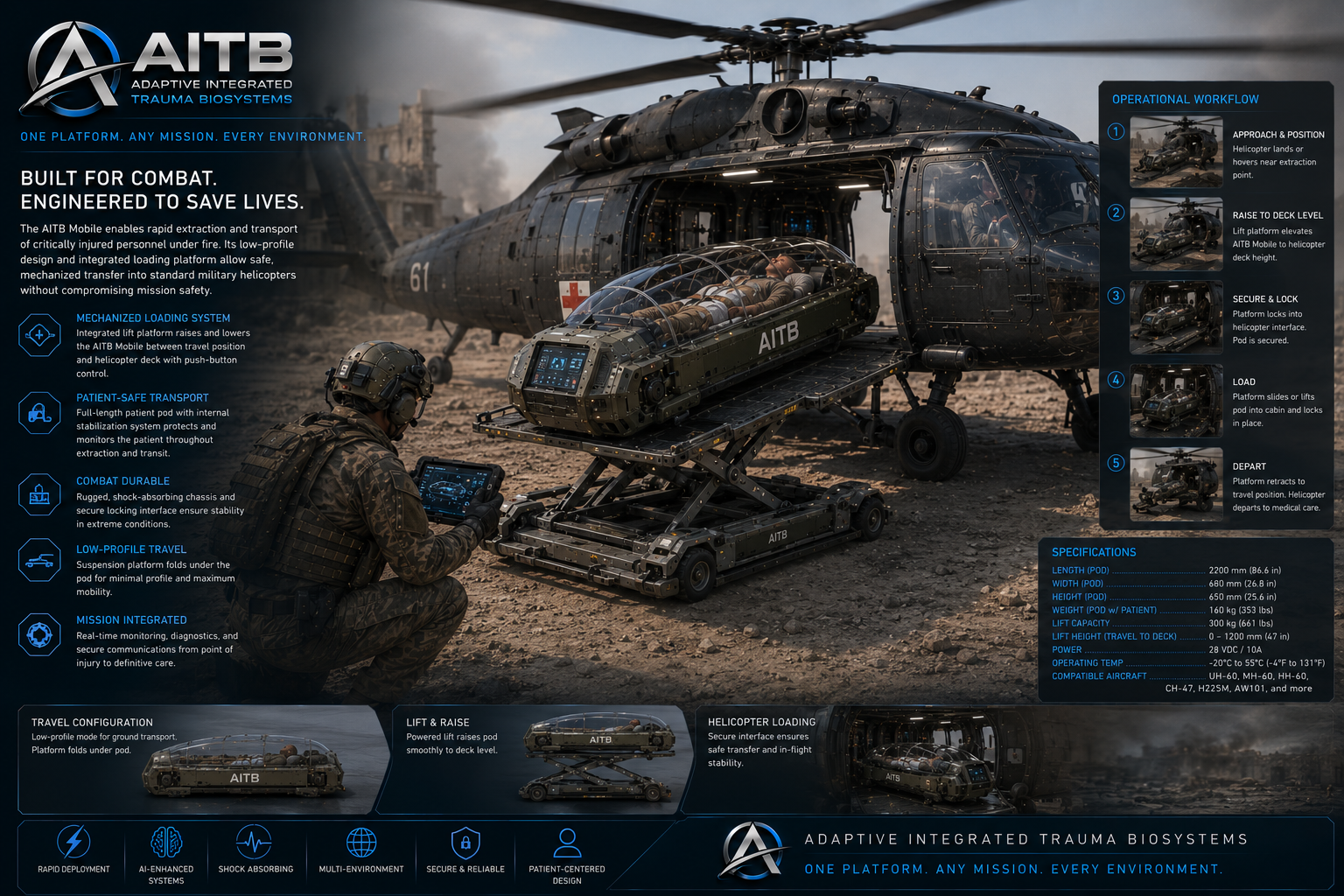
Combat and medevac optimized. Military-grade ballistic transparent dome, Kevlar or composite protective lower shell, rechargeable independent power, security systems, ruggedized electronics, and hardened transport interfaces.
Compact hospital mobility base for smooth floors, controlled facility turns, elevator entry, ambulance transfer, smart docking rails, and low-noise movement in clinical environments.
Rugged all-terrain mobility system for field conditions, uneven ground, helicopter staging, powered lift alignment, transport lock-in, and chassis-to-pod separation during aircraft loading.
Emergency department, ICU, infectious isolation, long-term monitoring, rehabilitation, burn recovery, post-surgical care, bariatric transfer, telemedicine, and hospital-at-home extension concepts.
Battlefield stabilization, medevac, helicopter transport, forward surgical teams, disaster response, contaminated environments, remote trauma support, and protected critical-care movement.
Civil gateway dashboard
Use these gateway cards to route hospital systems, investors, clinicians, emergency medical teams, rehabilitation partners, and institutional reviewers into the appropriate Civil AITB technical pathway.
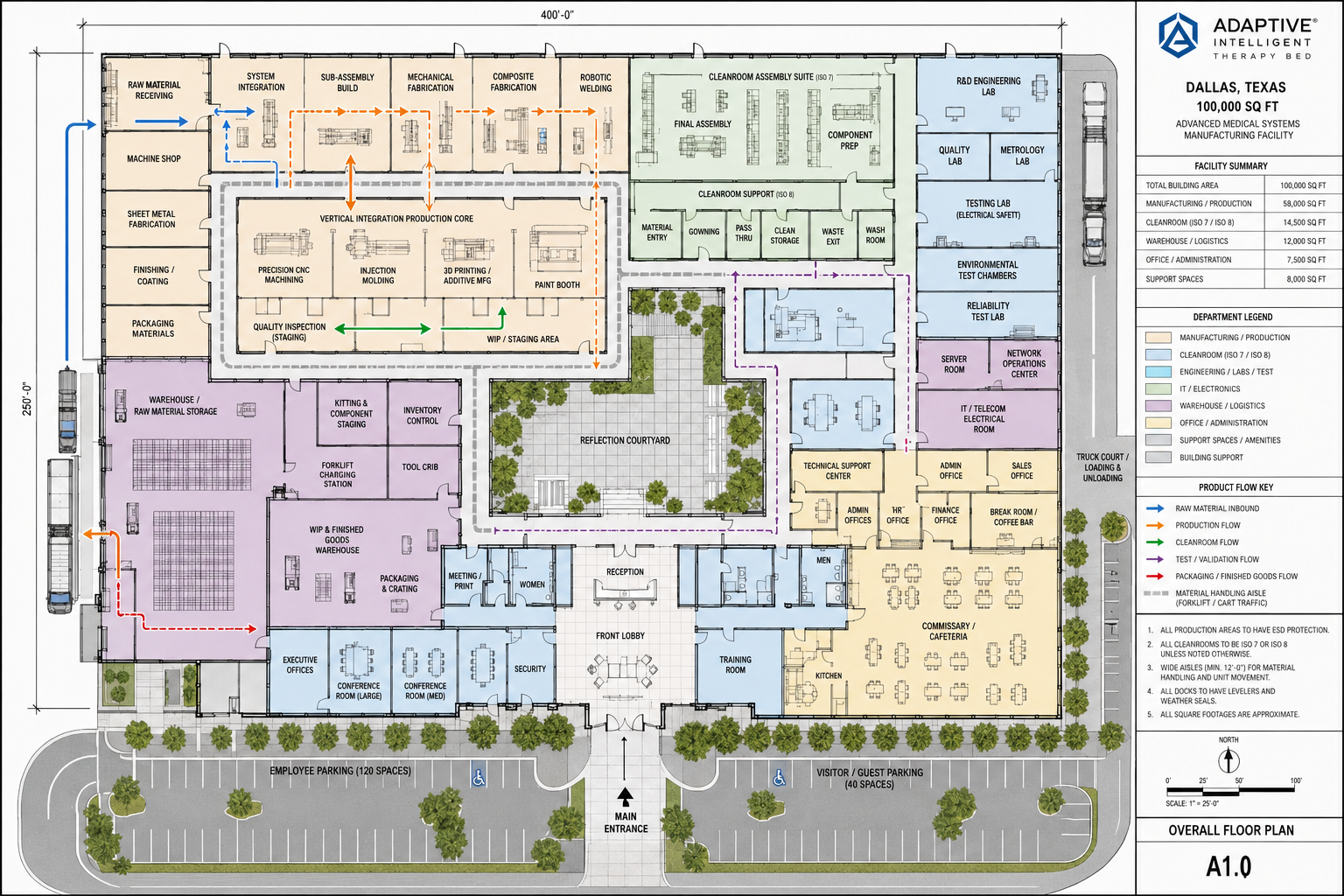
Lean production flow
The planned Dallas facility supports raw material receiving, machining, composite fabrication, robotic fabrication, clean assembly, system integration, test validation, packaging, finished goods storage, and outbound logistics.
Receiving, inspection, raw material storage, inventory control, and component staging.
CNC machining, sheet metal, composites, additive manufacturing, and robotic welding.
Controlled environment preparation, component assembly, gowning, pass-through, and final build.
Electronics integration, quality lab, metrology, environmental chambers, reliability testing, and validation.
Kitting, crating, finished goods staging, documentation, loading docks, and deployment logistics.
Production reference
Institutional inquiry
For government agencies, military medical teams, hospital systems, emergency response organizations, aerospace partners, manufacturing partners, and institutional stakeholders.